

On May 1, 2026, an amendment to the Federal Labor Law was published in the Official Gazette of the Federation, establishing the gradual reduction of the standard workweek from 48 to 40 hours without affecting employees’ salaries or benefits.
Main Changes
- The workweek will be gradually reduced until reaching 40 hours per week by 2030.
- The maximum weekly working hours will decrease progressively beginning in 2027.
- Working hours may be distributed by mutual agreement between employer and employee.
- New limits and payment rules for overtime work are established.
- Employers must implement an electronic working-hours registration system.
- Failure to comply with these obligations may result in penalties and fines.
Effective Date
The reform entered into force on May 2, 2026, one day after its publication in the Official Gazette of the Federation.
The reduction of the workweek will be implemented gradually from 2027 through 2030, allowing companies time to adjust their operational and administrative structures.
The period from May to December 2026 will serve as a transition and adjustment phase for employers.
The provisions regarding electronic attendance and working hours records will become effective on January 1, 2027.
Workweek Reduction Schedule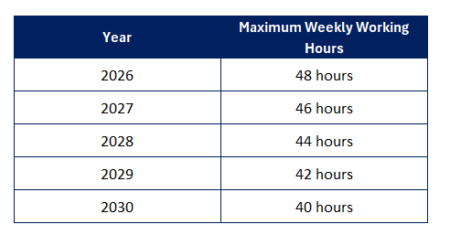
Overtime Hours (Article 66)
Overtime work will be subject to progressive limits as the workweek reduction advances. During 2026 and 2027, overtime may not exceed 9 hours per week; in 2028 the limit will be 10 hours; in 2029 it may reach up to 11 hours; and beginning in 2030 the maximum permitted overtime will be 12 hours per week.
These hours may be distributed in shifts of up to 4 hours per day, for a maximum of 4 days per week. Overtime must be paid at 100% above the employee’s regular hourly wage.
Excess Overtime (Article 68)
Any overtime exceeding the legal limits must be compensated at 200% above the ordinary hourly wage.
Under no circumstances may the combined ordinary and overtime work exceed 12 hours per day.
Electronic Workday Record (Article 132, Section XXXIV)
Employers will be required to maintain an electronic record of attendance and working hours for each employee. This record may serve as evidence in labor disputes.
Failure to comply with this obligation may result in fines ranging from 250 to 5,000 UMA units.
Companies are encouraged to review work schedules, shifts, staffing structures, and operational models in preparation for these changes. Employers should also update internal policies, employment agreements, and attendance control systems to ensure compliance with the new labor requirements.
For guidance on how these reforms may impact your organization and how to ensure compliance, Mexcentrix can help. Contact us to learn how we can support your company during this transition.